businesses.
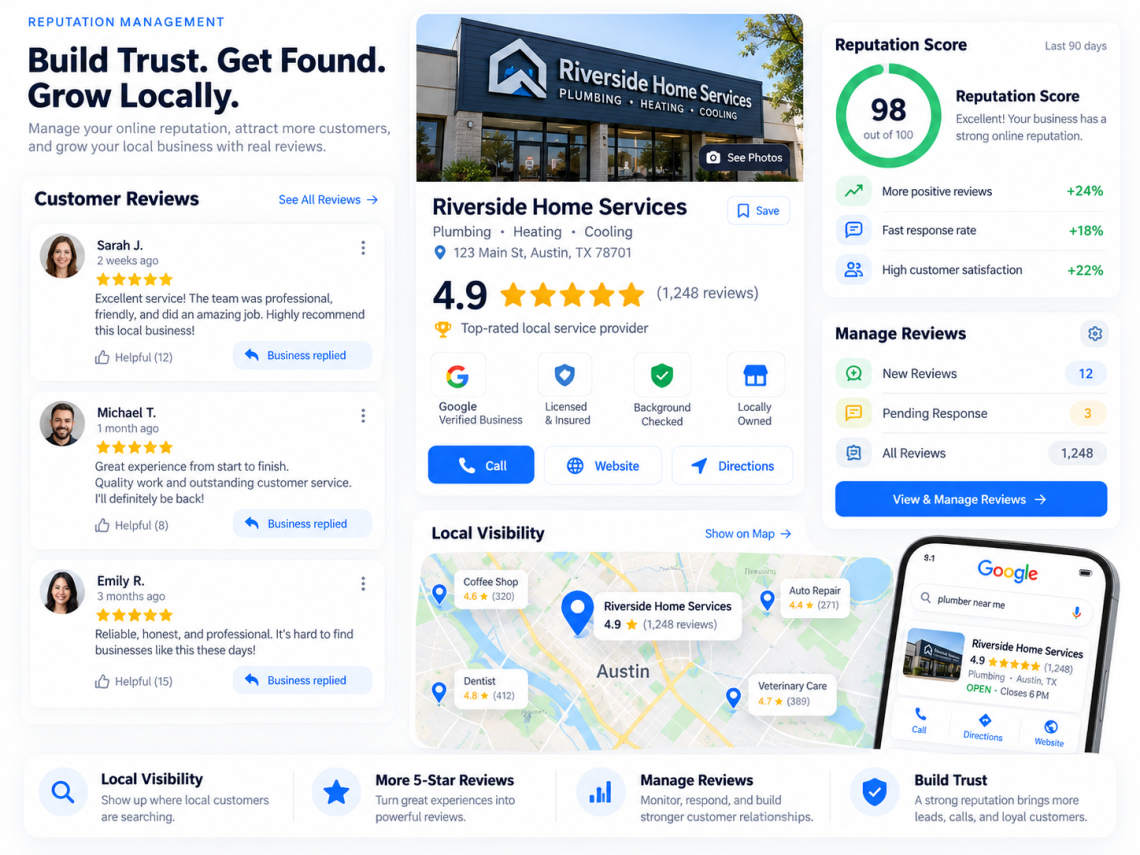
A potential customer may look at a business’s rating, number of reviews, recent
feedback, photos, and owner responses before ever visiting the website.
For many local businesses, reviews influence both perception and action.
They can help someone decide whether to call, book, visit, request a quote, or
continue searching for another option.
That makes review management more than a reputation task.
It is part of the overall customer experience and local digital presence.
Why Reviews Matter for Local Businesses
Local customers often make decisions quickly.
Someone searching for a restaurant, dentist, attorney, plumber, contractor, or
salon may compare several businesses within a few minutes.
Reviews can help answer questions such as:
- Do customers generally have a good experience?
- Does the business appear active?
- Are recent customers satisfied?
- How does the company handle problems?
- Does the business seem trustworthy?
A review profile can therefore act as a public record of customer experience.
Reviews Influence More Than Star Ratings
Many business owners focus only on average rating.
But customers may evaluate several review characteristics at once.
- Average rating
- Total number of reviews
- How recent the reviews are
- What customers actually say
- Whether reviews look genuine
- How the business responds
- Whether the same complaints appear repeatedly
A 4.7 rating with detailed recent reviews may create a different impression from
a 5.0 rating based on only a few old reviews.
Review Recency Can Influence Customer Perception
A business may have hundreds of reviews, but customers can still wonder whether
the information reflects the current experience.
Recent reviews can show that:
- The business is still active
- Customers are still using the service
- Current employees are delivering a consistent experience
- The business continues to receive feedback
This does not mean a business needs a new review every day.
A natural ongoing pattern is usually more useful than short bursts followed by
long periods of inactivity.

Review Quantity Provides Context
The number of reviews can influence how much confidence a customer places in the
overall rating.
For example:
5.0 stars from 3 reviews
and:
4.8 stars from 350 reviews
provide different levels of customer evidence.
That does not mean a business should chase review quantity at any cost.
The reviews still need to represent genuine experiences.
The Content of Reviews Matters
Star ratings alone do not tell the entire story.
Customers often read written feedback to understand specific experiences.
A detailed review may mention:
- Customer service
- Communication
- Speed
- Professionalism
- Quality of work
- Pricing experience
- Specific services
- Staff members
These details can help future customers determine whether the business fits
their needs.
Reviews Can Reveal What Customers Value
A review profile can also function as informal customer research.
If customers repeatedly praise:
- Fast communication
- Clean work
- Friendly employees
- Clear pricing
- Easy scheduling
the business gains insight into what customers value most.
Those strengths may be worth reinforcing across the website and broader
marketing.
Negative Reviews Can Reveal Operational Problems
Negative reviews are not only a reputation problem.
They can expose recurring issues inside the business.
If several unrelated customers complain about:
- Missed appointments
- Slow responses
- Unexpected charges
- Poor communication
- Long wait times
the problem may require an operational fix rather than a better review response.
Online Reputation Starts Offline
The most sustainable review strategy begins with the actual customer experience.
It is difficult to maintain a strong reputation if the underlying service is
consistently poor.
Review management can improve communication and visibility, but it cannot
permanently compensate for operational problems.
Better service usually creates better conditions for better reviews.
Google Reviews and Local Businesses
Google reviews are especially visible because they can appear directly alongside
a business’s Google profile.
Potential customers may see review information while:
- Searching on Google
- Using Google Maps
- Comparing nearby businesses
- Viewing a specific business profile
For this reason, Google reviews often become an important part of the local
customer journey.
Reviews and Local Search Visibility
Reviews are commonly discussed as part of local SEO because they contribute to
the information and reputation surrounding a business.
However, businesses should avoid reducing review strategy to one simplistic
idea such as:
More reviews automatically equal higher rankings.
Local search visibility depends on many factors, and individual ranking outcomes
can vary.
Reviews should primarily be viewed as genuine customer feedback and a trust
signal, with search visibility considered as part of the broader local SEO
picture.
Do Review Keywords Matter?
Customers naturally mention services, products, locations, employees, and
problems in reviews.
Those descriptions can provide useful context about the business.
But businesses should not pressure customers to write specific keywords or
script reviews purely for SEO.
The most credible reviews are written naturally by real customers.
Should Businesses Ask for Reviews?
A business can build a consistent process for asking genuine customers to leave
feedback.
The request should be straightforward and easy to understand.
A simple approach might be:
- Complete the service or transaction.
- Make sure the customer has actually received the experience.
- Ask for honest feedback.
- Provide an easy route to the review platform.
The process should not depend on whether the customer is expected to leave a
positive rating.
Make Review Requests Easy
Customers are less likely to leave feedback when the process is complicated.
Businesses may reduce friction by providing:
- A direct review link
- A short follow-up message
- An email request
- A post-service reminder
The exact method should fit the customer relationship and the platform’s current
policies.
Timing Matters
Review requests are often most useful when the customer can still clearly
remember the experience.
For a contractor, this may be shortly after the work is completed.
For a restaurant, the timing may be very different.
For a professional service, the appropriate moment may depend on the type of
engagement.
There is no single review request schedule that fits every business.
Do Not Manufacture Reviews
A review profile should represent real customer experiences.
Businesses should avoid practices such as:
- Purchasing fake reviews
- Creating fake customer accounts
- Writing their own customer reviews
- Using fabricated identities
- Posting reviews for services that never occurred
Artificial reviews can mislead customers and create unnecessary platform and
reputation risk.
Do Not Hide Every Negative Experience
A completely perfect review profile is not always more believable.
Real businesses occasionally receive criticism.
The important question is often how the business responds and whether the same
problem continues to appear.
A professional response to a legitimate complaint can sometimes build more trust
than pretending no customer has ever been dissatisfied.
Responding to Positive Reviews
Positive review responses do not need to be long.
A useful response can:
- Thank the customer
- Acknowledge something specific when appropriate
- Keep the tone natural
- Avoid excessive promotional language
The response should feel like communication, not another advertisement.
Avoid Copy-and-Paste Review Responses
Using exactly the same response for every review can make the business appear
automated or inattentive.
For example, repeating:
Thank you for your five-star review. We appreciate your business.
hundreds of times provides little value.
Responses can remain concise while still showing reasonable variation.
Responding to Negative Reviews
Negative reviews require more care.
A useful response generally avoids escalating the situation.
Consider the following approach:
- Read the review carefully.
- Check what actually happened.
- Respond calmly.
- Acknowledge legitimate concerns.
- Avoid revealing private information.
- Offer an appropriate offline next step when necessary.
Do Not Fight With Customers Publicly
A public argument may attract more attention than the original complaint.
Even if the business believes a review is unfair, future customers are also
evaluating the response.
Hostile language, insults, threats, or long emotional explanations can damage
the business’s reputation beyond the individual review.
Remember the Second Audience
When responding to a review, there are usually two audiences.
The first is the reviewer.
The second is every future customer who reads the exchange.
A response should therefore demonstrate how the business communicates when
something goes wrong.
Protect Customer Privacy
Public review responses are not the place to reveal private customer
information.
Depending on the industry, sensitive information may include:
- Medical details
- Legal matters
- Financial information
- Account information
- Private service records
Move sensitive discussions to an appropriate private channel.

What About Fake or Inappropriate Reviews?
Businesses occasionally encounter reviews they believe are fake, irrelevant, or
otherwise inappropriate.
When this happens, document the issue and use the review platform’s available
reporting process where appropriate.
Do not assume every negative review qualifies for removal simply because the
business disagrees with it.
Platform rules determine whether content is eligible for removal.
Monitor Reviews Across Important Platforms
Google may be important, but customers can discuss businesses elsewhere.
Relevant platforms depend on the industry and market.
They may include:
- General review platforms
- Industry-specific directories
- Booking platforms
- Marketplace profiles
- Social platforms
Businesses do not need to monitor every website on the internet.
Focus on platforms that customers actually use.
Consistency Matters More Than Review Bursts
A business that receives 50 reviews in three days and then none for a year may
have a very different review pattern from a business receiving feedback
consistently.
A sustainable strategy should become part of the normal customer process rather
than a one-time campaign.
Train Employees on the Review Process
If several employees interact with customers, review requests should not depend
on one person remembering them occasionally.
A simple internal process can define:
- When a review is requested
- Who sends the request
- Which platform is used
- Who monitors new reviews
- Who handles difficult responses
Consistency becomes easier when responsibilities are clear.
Do Not Make Employees Promise Positive Reviews
Employees should not feel pressure to manipulate customers into leaving only
positive feedback.
The purpose of a review system should be to collect genuine customer experiences,
not manufacture a perfect score.
Use Reviews to Improve Website Messaging
Customer reviews can reveal language that real people use to describe the
business.
Suppose customers repeatedly mention:
- Fast emergency response
- Clear explanations
- Easy scheduling
- Clean work
Those themes may indicate which strengths deserve clearer explanation on the
website.
Do not copy customer reviews into marketing claims without considering accuracy
and permission where appropriate.
Reviews Can Reveal Missing Website Information
Customer feedback may also show where the website is unclear.
If customers repeatedly ask about:
- Service areas
- Parking
- Appointment requirements
- Pricing process
- Emergency availability
those questions may deserve clearer website content.
Feature Reviews Carefully on the Website
Testimonials can support trust when they represent genuine customer feedback.
If reviews are displayed on the website:
- Represent them accurately
- Do not change the meaning
- Avoid fabricating identities
- Keep outdated claims under review
The website should not present invented testimonials as real customer
experiences.
Rating Alone Is Not a Reputation Strategy
A business can have a strong average rating and still have reputation problems.
For example:
- Recent complaints may be increasing
- Responses may be aggressive
- Important service issues may appear repeatedly
- The review profile may be outdated
Reputation management requires looking beyond one number.
Track Review Trends
A simple review dashboard or spreadsheet can help identify changes over time.
Possible metrics include:
- Total reviews
- New reviews by month
- Average rating
- Response rate
- Recurring positive themes
- Recurring complaints
The objective is not to obsess over every individual fluctuation.
The goal is to identify meaningful patterns.
Compare Reviews With Competitors Carefully
Competitor review profiles can provide useful context.
Compare:
- Review volume
- Recency
- Average rating
- Customer themes
- Response behavior
Do not assume the business with the largest review count is automatically the
best competitor or has the strongest overall local SEO.
Review Strategy Should Fit the Industry
Different industries create different review patterns.
A busy restaurant may naturally receive more reviews than a specialized
professional service with a much smaller number of annual clients.
Raw review counts should therefore be interpreted in context.
Review Strategy Should Fit the Customer Journey
The right review request process depends on how customers interact with the
business.
A home service company may ask after the technician completes the job.
A restaurant may rely more heavily on post-visit prompts.
A professional service may need to wait until an appropriate point in the
relationship.
The process should fit the actual experience.
Do Not Over-Automate Customer Communication
Automation can make review requests easier to manage.
But excessive automation can create problems.
For example:
- Sending requests before service is completed
- Sending repeated reminders
- Requesting reviews from the wrong customer
- Using robotic responses for sensitive complaints
Automation should support good communication rather than replace judgment.
How Reviews Connect With Google Business Profile
Reviews are one part of the broader information customers can see on a Google
Business Profile.
Businesses should review the entire profile together, including:
- Business information
- Categories
- Photos
- Services
- Hours
- Reviews
For a complete walkthrough, see the
Google Business Profile Guide.
A Simple Review Management Workflow
- Deliver the customer experience.
- Ask genuine customers for honest feedback.
- Make the review process easy.
- Monitor important platforms.
- Respond to reviews professionally.
- Investigate recurring complaints.
- Report inappropriate reviews where justified.
- Track meaningful reputation trends.
- Improve operations based on useful feedback.
Common Review Management Mistakes
| Mistake | Better Approach |
|---|---|
| Buying fake reviews | Build a process for genuine customer feedback |
| Focusing only on star rating | Review content, recency, volume, and responses |
| Ignoring negative reviews | Respond professionally where appropriate |
| Arguing publicly | Stay calm and move sensitive issues offline |
| Using identical responses | Use concise but natural replies |
| Requesting reviews only once a year | Make feedback part of an ongoing process |
| Ignoring recurring complaints | Investigate the underlying business issue |
What Should a Business Improve First?
If the current review profile is weak, begin with the fundamentals.
- Make sure customers are receiving a good experience.
- Identify the platforms that matter most.
- Create a simple genuine review request process.
- Respond to recent reviews where appropriate.
- Investigate repeated negative themes.
- Continue collecting feedback consistently.
Do not begin with shortcuts designed to create a large number of artificial
reviews.
Reviews Are a Reflection of the Business
A review strategy works best when it connects reputation management with the
actual customer experience.
Real reviews help future customers understand what to expect.
Review responses show how the business communicates.
Recurring complaints reveal where improvements may be needed.
Positive feedback highlights what the company is already doing well.
For local businesses, the goal should not be a mathematically perfect review
profile.
The goal should be a credible, current, and useful representation of genuine
customer experiences.
For a wider review of local visibility, use the
Local SEO Checklist.
Businesses focused on Louisville can also read the
Louisville SEO Guide.

